
Nikro Air Duct Cleaning in Denton: A Homeowner’s Guide
Any company can tell you they use “professional equipment.” Far fewer will quote you the numbers behind that claim. Nikro equipment is rated by cubic feet per minute of airflow and by how many stages of HEPA filtration it runs, and those figures are published for anyone to check. So when a contractor leans on the Nikro name without knowing the specs, that tells you something about how carefully the job will be run. This guide explains what Nikro gear actually does inside your ducts, why it matters in a Denton home, and the exact questions to ask before you sign anything.
What Does Nikro Equipment Actually Do Inside Your Ducts?
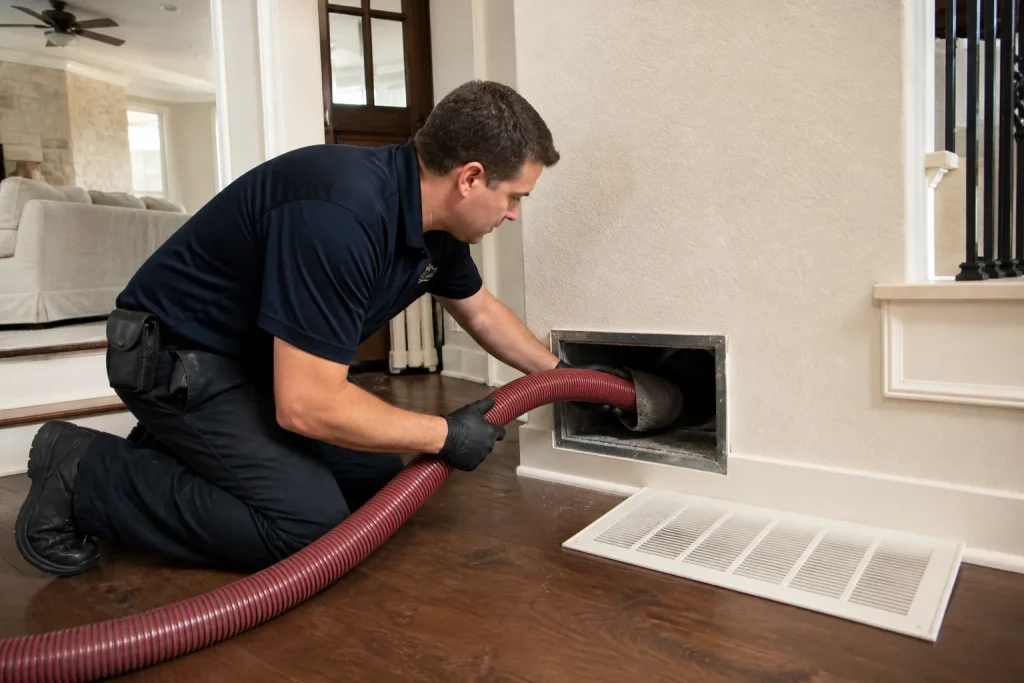
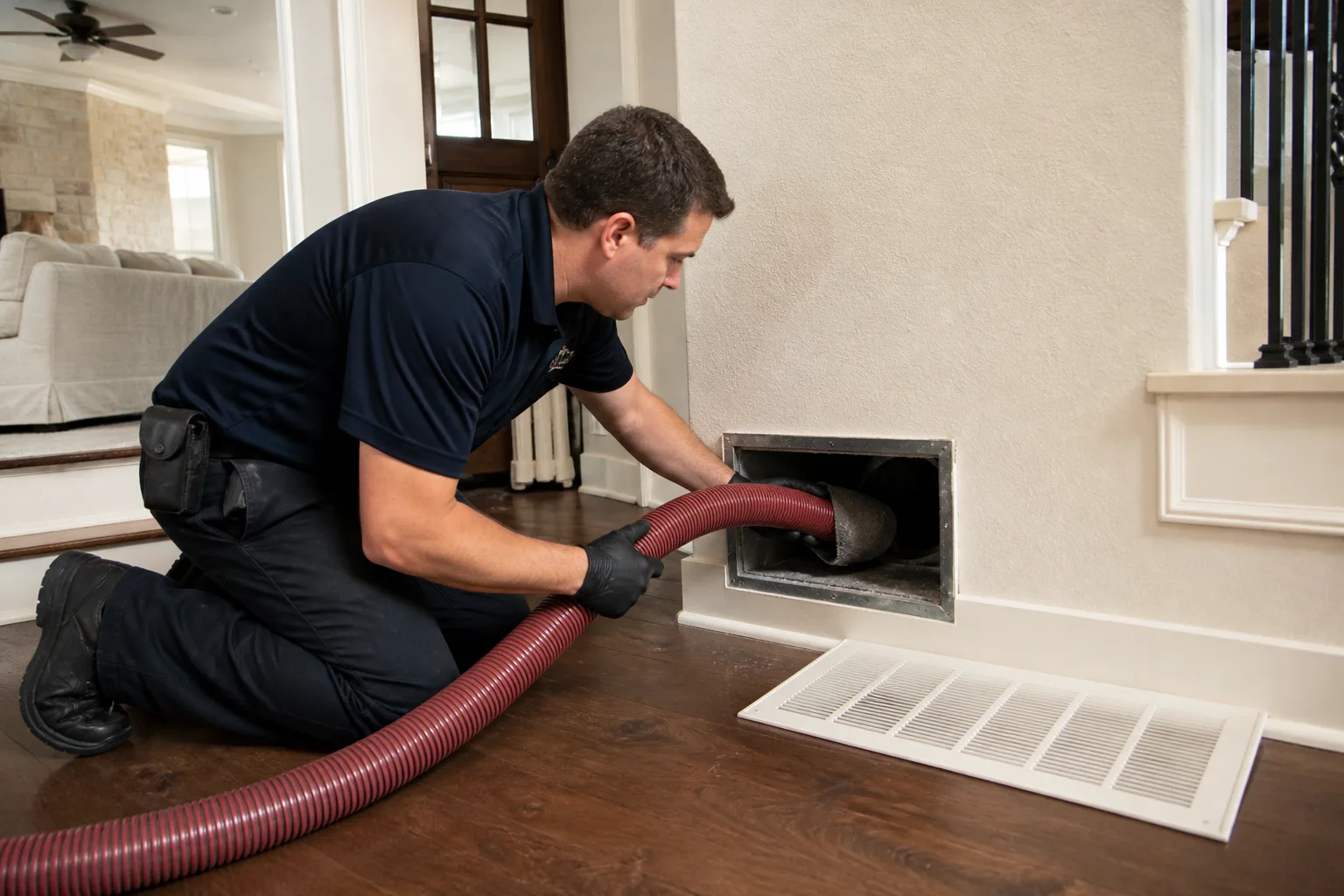
Nikro equipment is built for containment and extraction, not for blowing air around. That distinction is the whole point. A shop-vac-style rig pulls dust from the vent it sits on, but it also disturbs debris deeper in the system and lets fine particles drift back into the room where you’re breathing. Nikro’s negative air machines work the other way: they hold the duct system under lower pressure than the room around it, so loosened dust gets pulled toward the machine instead of pushed into your living space. A rotary brush agitates the debris off the duct walls, and the vacuum captures it in the same motion.
Here’s the plain physics. Air moves from high pressure to low pressure every time. If the machine inside your ducts creates a pressure drop relative to the room, the room’s air wants to flow in, and contaminants stay trapped in that inward current. If the machine can’t hold that pressure drop, or the vacuum’s filtration isn’t fine enough, particles escape. HEPA filtration is what catches the microscopic fraction that would otherwise pass straight through a standard filter and settle on your furniture an hour after the crew leaves.
In our experience, the equipment matters most in homes with pets, recent renovations, or a long stretch of skipped maintenance. Those are the Denton houses where a big volume of loose debris meets a system that can’t contain it without the right machine.
Residential vs. Commercial Nikro Configurations: Which Fits a Denton Home?
Nikro makes equipment for very different building types, and matching the unit to the home is part of doing the job correctly. A compact residential configuration with a rotary brush and a portable HEPA vacuum is the right fit for most single-family homes in Denton, including older houses near the courthouse square where duct runs are shorter and the system holds fewer cubic feet of air. These setups are designed to work with typical residential duct diameters.
Bigger builds, additions with long trunk lines, and multi-zone systems can need more airflow capacity and a second vacuum connection to keep negative pressure stable across the whole system. That’s where a larger Nikro negative air machine or a truck-mount unit earns its keep. A single portable unit fighting a large system may technically run, but it can’t hold containment across all those runs at once, so debris in the far zones gets agitated without being captured.
The practical rule for a homeowner:
- Standard single-family home: a residential portable unit with HEPA filtration and a rotary brush is appropriate.
- Large or multi-zone home: ask whether the crew will run a second machine or a higher-capacity negative air unit to maintain containment.
- Truck-mount vs. portable: truck-mount rigs offer more raw airflow, but they still need a hose connection at the system and a properly sealed access point to do anything useful.
What shouldn’t happen is a crew showing up with a consumer vacuum and calling it professional. The equipment decision should be made for your house, not for the crew’s convenience.
What Nikro Equipment Won’t Fix (and Why Technique Still Wins)
Good equipment doesn’t clean ducts by itself. It amplifies whatever technique the operator brings, both the good and the bad. The machine’s job is containment and extraction; the operator’s job is deciding where to cut access, how to seal it, how to sequence the zones, and how much agitation each run needs. A superb negative air unit paired with lazy brush work will leave dust on the walls. A modest machine in skilled hands, with proper access points and patient agitation, can still do a clean job.
Access point strategy is where the work actually gets made or missed. Every branch line needs a point where the brush and vacuum can reach the full run, and every point needs to be sealed afterward so the system is as airtight as it was before. On older Denton homes, that often means finding flexible duct runs that have been squashed or taped over, and deciding whether a line needs repair before cleaning even makes sense. We repair what others just clean around, because a leaking or disconnected run is a hole where all the cleaning effort drains away.
Three things that matter more than the model number on the machine:
- How many access points the operator opens, and whether they seal them fully when done.
- Whether they clean the supply and return sides, plus the blower compartment you can safely reach.
- Whether they check the system for leaks or damage and flag it, rather than cleaning past it.
For a deeper technical look at what a full cleaning involves, our page on air duct cleaning walks through the process step by step.
How Do You Verify a Denton Contractor’s Equipment Before Booking?
Ask directly, and expect specifics. A knowledgeable crew can answer these in a sentence or two. If the answer is “we use professional equipment” with nothing else, that’s your answer. Here’s what to ask before you commit:
- What’s the CFM rating of your vacuum? Cubic feet per minute is the airflow the machine pulls. Higher CFM means faster, more stable negative pressure, but the number only helps if it’s matched to your system’s size.
- How many stages of HEPA filtration does it run? HEPA captures the fine particulate that a coarse filter lets through. Multiple filtration stages protect the machine and keep exhaust air clean.
- Are you using truck-mount or portable equipment? Either can work. The follow-up question is whether the configuration is right for your home’s size.
- Do you use negative air practices? This is the containment question. You want the answer to be yes and to hear the operator describe how they hold the system under lower pressure than the room.
- Will you show before-and-after photos of my own ducts? Anybody can clean a system and describe it later. Photos of your ductwork are the proof.
One more worth asking: what filtration and air quality system does your home already have? If you’ve invested in whole-home filtration, familiarity matters, and crews used to working alongside Honeywell or Aprilaire systems will know how to service the ductwork without disrupting the equipment connected to it. If a contractor’s eyes glaze over at those names, that’s information too.
When you’d rather not spend an afternoon playing 20 questions with contractors, call a pro. Call (888) 890-4255 and ask for the equipment spec up front. We answer 24/7.
What “Restoration-Grade” Means for Your Home’s Air
Restoration contractors have a higher bar than general cleaners, because they work in buildings with mold, fire residue or heavy contamination. Equipment built for their world is designed to contain and remove contaminants at a level a residential sweep-up isn’t. Abatement Technologies negative-air practices come from the same restoration mindset: seal the space, pull air through filtered negative pressure, and keep dislodged debris from recirculating into the home. That approach is why we run Abatement containment thinking alongside the Duct Cleaning Denton process on every job rather than treating it as an add-on.
The result worth asking about is the air itself. Post-cleaning indoor particulate levels are a measurable outcome, not a vague promise. Before and after the work, the difference in what’s floating around the room can be observed and photographed. Fine dust, pet dander, and renovation grit should settle out of the air at a lower level afterward, not get stirred back up. That’s what separates restoration-grade containment from a blow-and-go service, and it’s the reason the equipment spec matters to a family with allergies or a toddler crawling on the floor.
It’s also worth knowing where duct work stops and other trades begin. Duct cleaning handles the air distribution system. It doesn’t handle mold remediation, full HVAC replacement, or chimney work, and any provider who tells you otherwise is stretching. Our focus is the ducts, the dryer vent, and duct repair, and we keep it there.
Where Nikro Fits Alongside Every Other Denton Air Quality Concern
Duct cleaning is one piece of a home’s air picture in Denton, and the equipment choices you make indoors also have a fire-safety companion outdoors. A clogged dryer vent is a leading cause of residential fires, and it’s a distinct service with its own urgency. Our dryer vent cleaning is handled as a safety-critical job, not bundled into the duct cleaning as an afterthought. The same restoration mindset applies: contain the lint, extract it fully, and verify the run is clear.
Duct repair rounds out the picture. A home’s duct system is often dirty and leaking at the same time, and cleaning a leaking system without addressing the leaks wastes most of the effort. We repair what others just clean around, so the system you get back is both cleaner and tighter than the one we opened. For homeowners across Denton, the combination of clean, sealed, well-filtered ductwork is what actually moves the needle on indoor air quality.
Here’s the small humor in all of this: your ducts never call to complain. They just quietly collect whatever you give them, year after year, and ask nothing in return. The least we can do is know the equipment before we crawl through the house.
The Bottom Line
Nikro equipment is restoration-grade for one reason: it’s rated, verifiable, and designed to contain what it loosens. Before you hire anyone in Denton, ask for the CFM rating, the HEPA filter stages, whether they run truck-mount or portable units, and whether they practice negative air containment. Ask for before-and-after photos of your own ductwork. If a contractor can answer all of that clearly, you’ve found a crew who treats the work like restoration, not a sweep-up.
- Negative air pressure traps debris in the system instead of blowing it into your room.
- Match the equipment configuration to your home’s size and number of duct zones.
- Technique and access point strategy decide the result as much as the machine does.
- Restoration-grade containment leads to measurably less particulate in your indoor air.
If you’re in Denton and need help, Duct Cleaning Denton offers free estimates. We use Rotobrush and Nikro systems with HEPA filtration and Abatement negative-air practices, and we can repair what others only clean around. Call (888) 890-4255. Our technicians have up to 11 years of experience, and the estimate is free with a written price agreed before any work starts.
Frequently Asked Questions
Nikro air duct cleaning means using Nikro Industries equipment, which is restoration-grade vacuum and negative air machinery, to pull and contain debris from a home’s duct system. It’s built for contain and extract, not blow and go. Rather than scattering dust into the room, the machine holds the ducts under lower pressure than the room so loosened debris flows inward and gets captured through HEPA filtration. The result is a system clean on the walls and cleaner air in the room after the work.
Whole-system pricing depends on your home’s size, number of duct runs, and how much debris is inside. That’s why quotes vary. We give a single flat price per system agreed before work starts, with no per-vent pricing and no teaser figure that grows once the technician is on site. Call (888) 890-4255 for an exact quote. Estimates are free, and the written estimate sets the final price.
Much cheaper usually means much less equipment and less containment. A low quote often reflects a portable consumer-grade vacuum that agitates dust without trapping it, plus limited access points. Restoration-grade machines, HEPA filtration stages, and negative air containment cost more to run, and the difference ends up in the air you breathe. If a quote looks dramatically lower than the rest, ask what machine and filter stages it includes. Then call (888) 890-4255 and compare against a real equipment spec.
Ask for before-and-after photos of your own ducts. Photos of your system, not a stock image, are the clearest proof that the dirt came out and the runs were cleaned. Combine that with a written summary of access points opened and sealed, and you have a verifiable record of the job. If that feels like a fair ask, call (888) 890-4255 and we’ll walk you through what we’ll photograph before we start.
Most homes benefit from a cleaning every few years, but the real answer depends on the house. Homes with pets, recent renovations, new construction dust, or a long history of skipped maintenance often need it sooner. A household with allergy sufferers and young children has a stronger reason to stay on a schedule. If it’s been a while since the ducts were opened, call (888) 890-4255 for a free look at whether cleaning is actually warranted.
Written by the team at Duct Cleaning Denton.
Need Air Duct Cleaning Help?
Call Duct Cleaning Denton - licensed & insured, with free written estimates in Denton.
(888) 890-4255