
Emergency Air Duct Cleaning Near Me: What Denton Homeowners Should Do First
If you’ve just found mold growth or rodent activity in your duct system, the worst thing you can do is run your HVAC while you search for a cleaner. Those first 20 minutes decide whether contamination stays in one section of ductwork or gets pushed into every room of your house. The steps below are what we’d do in that moment, before anyone loads equipment. If you’d rather have a professional handle it, call (888) 890-4255.
What Actually Counts as a Duct Emergency in Denton?
Most calls we get for “emergency” duct work in Denton are urgent-feeling but not true emergencies. A musty smell after a week away, a little dust blowing from a vent, or a system that seems to cycle more than it should are real concerns worth scheduling, but they don’t need a same-hour response. Knowing the difference saves you money and prevents a contractor from upselling you on a job that could wait.
True duct emergencies in Denton share one trait: contamination is actively spreading or the system itself is part of the problem. Those cases fall into four categories:
- Visible mold growth inside a supply or return duct, on the coil housing, or around registers
- Rodent or pest intrusion where droppings, nesting material, or a dead animal is inside the ductwork
- Smoke or fire damage where soot has entered the system and is recirculating through the home
- Post-flood contamination where standing water or high humidity after a leak has allowed biological growth inside the ducts
A slow buildup of dust, a pet-hair-heavy return, or a system that hasn’t been cleaned in years is a standard air duct cleaning need, not an emergency. Both matter, but they require different responses and different equipment.
The 30-Minute Shutdown Protocol For Each Duct Emergency
The first move in every case is stopping the spread. That means turning the system off at the thermostat and, if you can reach it safely, at the breaker. Running the fan recirculates whatever is inside the ducts, so the air in every room gets a fresh dose every cycle. This is the single most important step before you call anyone.
Mold discovery
- Turn the system off at the thermostat and the air handler breaker.
- Close the registers in the affected room to slow cross-migration.
- Don’t spray bleach or vinegar into the vent. It kills surface mold but doesn’t remove spores from the duct lining, and the moisture can make the problem worse.
- Photograph the growth with something for scale (a coin, a tape measure) before anyone touches it.
Rodent intrusion
- Shut the system down. Rodent droppings carry pathogens and running the fan aerosolizes them.
- Leave the area and keep children and pets out.
- Don’t vacuum with a shop vac. Consumer vacuums exhaust fine particles back into the room.
- Note where you saw the activity (register, return, or both) so the technician knows where to start.
Smoke or fire damage
- System off, HVAC breaker off. Soot from a structure fire is acidic and can corrode the coil and blower if it circulates.
- Don’t run the system to “clear the smell.” You’re making the contamination worse.
- Start your insurance documentation immediately (more on that below).
Post-flood contamination
- System off. If water reached the air handler or ducts, don’t power anything until a technician checks it.
- Increase ventilation with open windows and box fans in the affected rooms, not through the HVAC.
- Photograph water lines and any visible growth before things dry.
How to Tell If You Need Emergency Duct Cleaning or Standard Cleaning
Here’s the honest answer: if you can’t see contamination, smell something that isn’t there, or point to a specific event (a fire, a flood, pests), you likely have a standard cleaning need. If you can see biological growth, smell a persistent musty or dead-animal odor that doesn’t go away, or had a documented smoke or water event, treat it as urgent and shut the system down first.
A few more tests we ask Denton homeowners to try:
- Does the smell follow the airflow? If it’s strongest at the registers when the fan is on, it’s likely in the ducts. If it’s strongest near a specific room, it might be a spill or a wet wall.
- Is there visible staining around a register? Dark rings around a vent often point to moisture in the duct or the boot behind it.
- Did an event happen recently? A kitchen fire, a washer overflow, a roof leak, or a rodent problem changes the timeline. Without an event, the odds of a true emergency drop considerably.
Be wary of any company that describes every call as urgent. In our experience, the phrase “emergency duct cleaning” is often used more by HVAC generalists looking for a fast sale than by specialists who understand what the work involves. Duct work that has been dirty for years won’t be solved by a same-day response; it needs the right process.
What to Tell a Denton Dispatcher So the Right Equipment Arrives
The difference between a routine cleaning call and a restoration-grade response comes down to what the dispatcher knows before a technician is sent. A generic “clean my ducts” request gets a routine visit. A clear description of a contamination event gets the right equipment and preparation the first time.
When you call, give the dispatcher these details up front:
- What you found (mold, droppings, soot, water damage) and where
- Whether the system is currently running or has been shut down
- When the event happened, if there was one (fire date, leak date, pest sighting)
- Whether anyone in the home has allergies, asthma, or immune concerns
- Whether there are pets or young children in the home
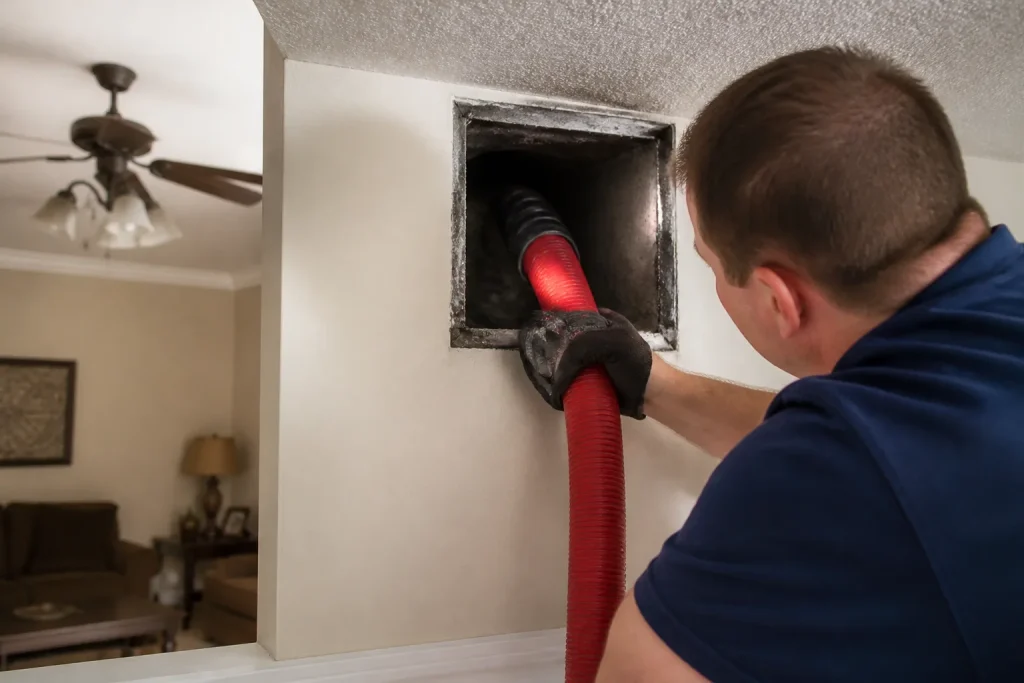
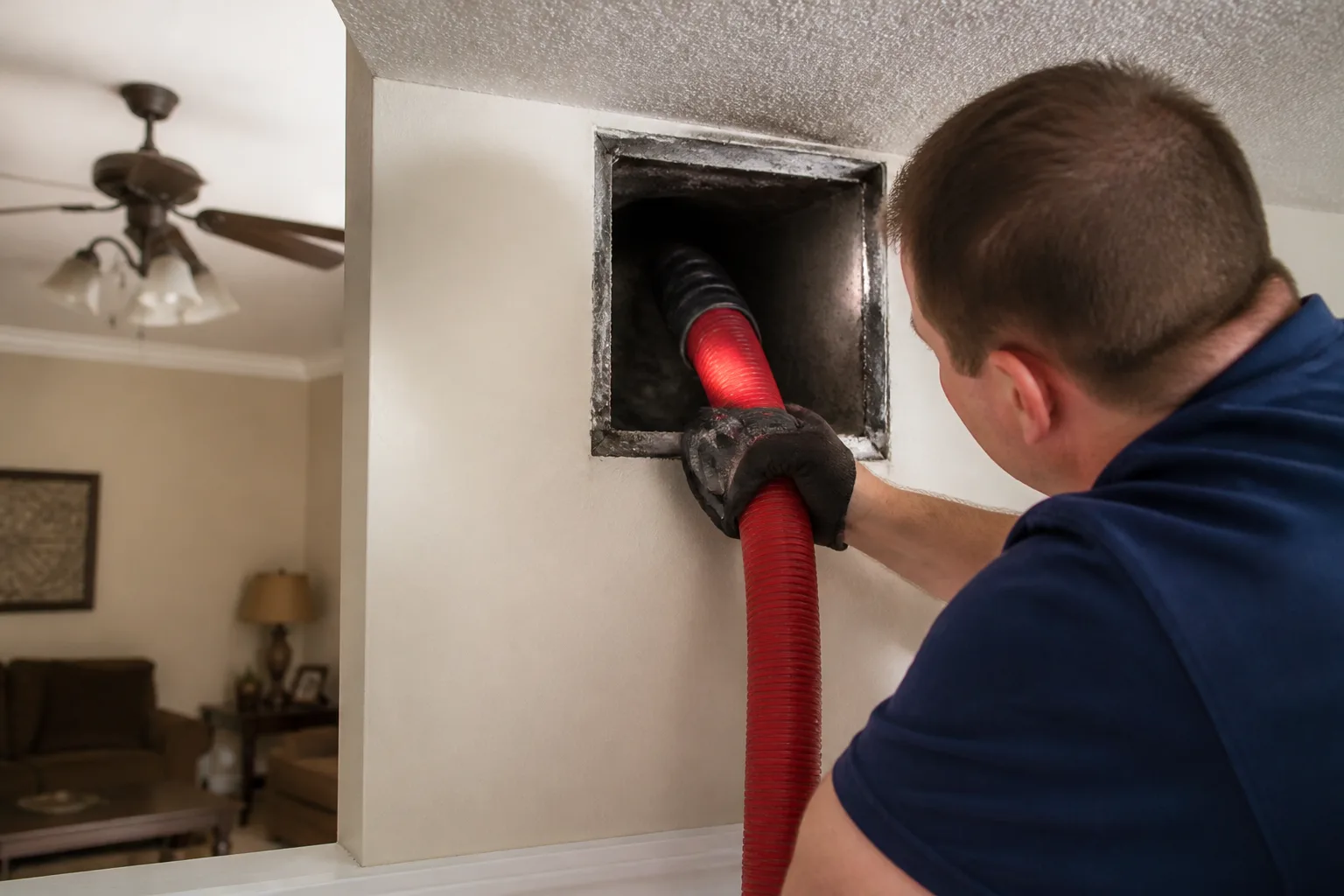
Why it matters: restoration-grade response usually means negative-pressure containment (abatement equipment that keeps dislodged particles from recirculating into the living space), HEPA-filtered extraction, and mechanical agitation with a rotary brush system. Routine cleaning can sometimes get by with lighter equipment; a contamination event can’t. We run Rotobrush and Nikro systems for exactly this reason, and familiarity with the different response types is what separates a specialist from a generalist HVAC call.
Our line is answered 24/7, and crews run on fast dispatch from 7am to 7pm, Sunday through Friday. A call outside dispatch hours is booked into the next opening.
Interim Air Quality Steps While You Wait
You can do a lot to protect the air in your Denton home between the first call and the technician arriving. None of these replace professional cleaning, but they lower exposure in the meantime.
- Isolate the affected rooms. Close doors and tape off registers if the contamination is confined to one area. This slows cross-migration into bedrooms.
- Run portable HEPA air cleaners in occupied rooms. Look for true HEPA filtration (not “HEPA-style”) and place units near where people sleep.
- Don’t run the central fan as an “air purifier.” Unless you have a whole-home system professionally designed for filtration, running the fan moves contamination around instead of removing it.
- Keep windows closed if outside air is smoky or pollen-heavy, and open them if inside air is stagnant and the outside air is cleaner. Use your judgment based on the season.
- If you have a Honeywell or Aprilaire whole-home filtration system, check that the filter is seated correctly and hasn’t been overwhelmed by the event. Familiarity with these systems matters when the cleaning is done, because the duct work needs to integrate with the existing air quality investment, not fight it.
Vacuums and box fans do more harm than good in this window. A standard shop vac will exhaust fine particles back into the room. Leave the debris in place until it can be extracted under containment.
Documentation to Gather If the Event Might Be Insurance-Eligible
Smoke damage, flood events, and HVAC system failures that contaminated the ducts are frequently covered under homeowner policies. What determines whether the claim goes smoothly isn’t the policy itself; it’s the documentation you gather in the first 48 hours.
Gather these before the cleaning begins:
- Photos and video of the contamination, with a coin or tape measure for scale
- Photos of the event source (burned area, water line, rodent entry point)
- Any receipts for items damaged as a result of the contamination
- A written record of when you noticed the problem and what you did in response
- A copy of the policy’s water damage and smoke damage coverage sections
Ask the cleaning company to provide written documentation of the scope of work, the equipment used, and before-and-after photos. Insurers typically need that record to process a claim, and a company that can’t produce it is a red flag. When we do this work, before-and-after photos of your own ducts are part of the deliverable, not an extra.
When to Call a Pro (and When Not To)
Call a professional the moment you have visible contamination, a confirmed event, or a system that isn’t moving air normally. Don’t call a pro for a dusty vent, a faint smell that clears up, or a system that just hasn’t been cleaned in a while; those are scheduled jobs, not emergencies. Also don’t call for a duct issue that’s really an HVAC mechanical problem; if the blower isn’t running or the coil is frozen, that’s an HVAC service call, not a duct cleaning one.
We repair duct systems, not just clean them, which matters here. Damaged or leaking ducts often sit behind a “dirty ducts” complaint, and cleaning around a leak doesn’t fix the underlying problem. If the shutdown protocol turns up a disconnected joint, a crushed section, or a boot that’s separated from the register, the fix belongs in the scope of work. Our technicians have up to 11 years of experience with this kind of diagnostic work.
Related Services in Denton
If the emergency turns out to be a standard cleaning need, our Denton service page walks through what a full job involves. If you also use a clothes dryer, our dryer vent cleaning service is a separate safety call worth scheduling; lint buildup in a dryer vent is one of the leading causes of residential fires and a different job from HVAC duct work. To see everything we offer, start at Duct Cleaning Denton.
What happens when you call
- 1
A real person answersNo phone trees – you reach a local pro.
- 2
You get an upfront price rangeHonest numbers before anyone is dispatched.
- 3
A background-checked tech heads outLicensed & insured, dispatched right away.
- 4
You approve before work beginsNothing starts until you say go.
The Bottom Line
The single most useful thing you can do in the first 30 minutes is turn the system off. Then assess what you’re dealing with (visible contamination and an event, versus a smell and a hunch), gather photos, and call a specialist who can describe the equipment they’d bring. A generalist with a shop vac and a coupon isn’t the right fit for a contamination event, and a specialist should be able to explain the difference between routine cleaning and restoration-grade response before they show up.
If you’re in Denton and need help, Duct Cleaning Denton offers free estimates. Call (888) 890-4255. We answer 24/7 with fast dispatch from 7am to 7pm, Sunday through Friday, and we’re closed Saturday.
Frequently Asked Questions
No. Turn the system off at the thermostat and at the air handler breaker. Running the fan moves mold spores from the duct into every room the system serves, which is exactly the outcome you’re trying to avoid. Keep it off until a technician has assessed the growth. Call (888) 890-4255 for a free estimate.
True duct emergencies exist, but they’re narrower than the marketing suggests. Visible mold, rodent intrusion, smoke damage, and post-flood contamination are the four cases that justify a fast response. Most calls described as urgent fall into standard cleaning territory. If you can’t point to a specific event or visible contamination, you likely have a routine job. Call (888) 890-4255 and we’ll help you decide which category you’re in.
It depends on the cause. Smoke damage, flood events, and HVAC failures that contaminated the ducts are frequently covered, while long-term buildup usually isn’t. Gather photos, receipts, and a written record of the event in the first 48 hours, and ask the cleaning company for written documentation of the scope and before-and-after photos. Call (888) 890-4255 for a free estimate and we can talk through what documentation makes sense for your situation.
Ask for before-and-after photos of your own ducts, a written scope of work, and a description of the equipment used. A specialist should be able to name the machines (Rotobrush for agitation, Nikro for HEPA extraction, Abatement Technologies for negative-pressure containment) and show you the results. If a company can’t produce photos of your ducts, that’s a problem. Call (888) 890-4255 for a free estimate.
Written by the team at Duct Cleaning Denton.
Need Air Duct Cleaning Help?
Call Duct Cleaning Denton - licensed & insured, with free written estimates in Denton.
(888) 890-4255