
How to Choose the Right Air Duct Cleaning Company in Denton
Choosing the right air duct cleaning company in Denton comes down to five equipment and process questions you can ask on the phone before you book: how much air the machine moves (CFM), whether it uses true HEPA filtration, whether it pulls the house under negative pressure or just pushes air around, how the crew gets into every run, and whether they photograph before and after. A NADCA listing and a clean review profile tell you a company exists. Those five answers tell you whether they’ll actually clear your system. If you’d rather not sort through the guesswork, call (888) 890-4255.
Most homeowners know the basics: check reviews, get a few quotes, verify they have insurance. Fair enough. But in Denton, where homes range from 1950s ranch houses near the courthouse square to newer builds out along the I-35 corridor, the biggest giveaway isn’t the marketing. It’s the equipment. A carpet-cleaning crew that added duct work as a side service and a restoration-grade specialist both show up with a vacuum and a hose. On a phone call, they sound similar. On your driveway, they look completely different.
This guide gives you a real framework. Not a checklist of credentials every company can pass, but the specific questions that separate a system-level cleaning from a blow-and-go visit.
Key Takeaways
- NADCA membership is a starting point, not a quality signal. How the equipment is built matters more.
- Ask about CFM, HEPA filtration, negative air, and access strategy before anyone books the visit.
- A quote given without knowing square footage or vent count is a sales call, not an estimate.
- Real cleaning ends with visual proof of your own ducts, before and after.
- In Denton’s older homes, duct damage often matters as much as the dirt. A cleaning-only company has nothing to offer you there.
The Five Equipment Questions to Ask Before You Book
These five questions are the core of this guide. If you ask nothing else, ask these. A specialist can answer all five without hesitation. A carpet-cleaning side operation will get quiet around number three.
1. What’s the CFM rating of your vacuum? CFM means cubic feet per minute, and it’s how much air the machine actually moves. The old industry rule of thumb is a true HEPA vacuum big enough to pull around 800 CFM or more per main trunk line, paired with agitation. If the person on the phone doesn’t know their number, that tells you something. A portable shop-style vac is in the very low hundreds. Pro-grade equipment is a different class of machine.
2. Is it a true HEPA filtration stage, or “HEPA-like”? HEPA captures particles at the fine end, which is exactly where the allergy-relevant dust lives. Under pressure of filtration quality, we run Nikro HEPA-filtration equipment, and the difference shows up in what stays out of the airstream when the brush hits a heavily soiled run.
3. Do you pull the house under negative pressure, or push and pull? Negative pressure means airborne debris gets contained and filtered rather than blown back into the home. We use Abatement Technologies units for that reason. This is standard practice on a restoration job, and it should be standard on your ducts too.
4. How do you access every run? Every duct has an entry strategy, and the right one depends on the house. A real crew will talk through register removal, trunk-line access, and whether any demolition or repair is needed afterward.
5. Will you photograph before and after? This is the simplest one and the most revealing. A company that photographs isn’t hiding anything. A company that dodges the question is telling you something.
If you want a full walk-through of what we do after those answers, our air duct cleaning page covers it.
Red Flags That Show Up in Denton Specifically
Denton is not a small town anymore, and the market has filled with operators who treat duct cleaning as a fill-in job. Some patterns are worth naming.
- “Free duct cleaning with carpet or HVAC service.” If the duct cleaning is thrown in as a bonus, the machinery doesn’t match the job. It’s a shop vac and a hose. You’ll get surface dust knocked back into the system, not system-level removal.
- A quote without questions. A real estimate starts with the size of your home, the number of vents and returns, and the condition of the runs. If someone gives you a firm number over the phone before asking any of that, they are selling a coupon, not a cleaning.
- Guarantees with no defined scope. “100% satisfaction” means nothing unless it says what will be done, how it will be verified, and what happens if it isn’t. A guarantee without a scope is marketing.
- No access to duct repair. Older Denton properties, especially anything that’s been renovated or had an add-on, often have crushed or disconnected flex runs. A cleaning-only company will clean around them. A specialist will tell you.
None of these are rare. We’ve seen all four more times than we’d like, which is why the phone call ahead of the visit matters so much.
NADCA Certified vs. NADCA Compliant: What the Label Actually Covers
Here’s the part most homeowners never hear. NADCA offers two things, and they are not the same: certification, which applies to the individual technician who passed their exam and continues to meet training requirements, and compliance or membership, which applies to the company. A company can be listed as a NADCA member without every tech on the truck being individually certified. Both matter. Neither tells you the CFM of the vacuum, whether the crew photographs their work, or how they handle duct damage they find mid-job.
In our view, NADCA membership is table stakes. It says a company is engaged with the industry and aware of the standards. What it doesn’t cover is service quality on your specific system, and that’s where the equipment and access questions from the previous section still do the real work. A NADCA-compliant company with consumer-grade gear is still a NADCA-compliant company with consumer-grade gear. The badge doesn’t change the vacuum.
So use the label as a filter for the first call, not a substitute for the questions.
How to Verify the Equipment Before Anyone Enters Your Home
Ask for a photo of the equipment on arrival. Anyone doing this work professionally will send one without hesitation. Here’s what to look for when it arrives.
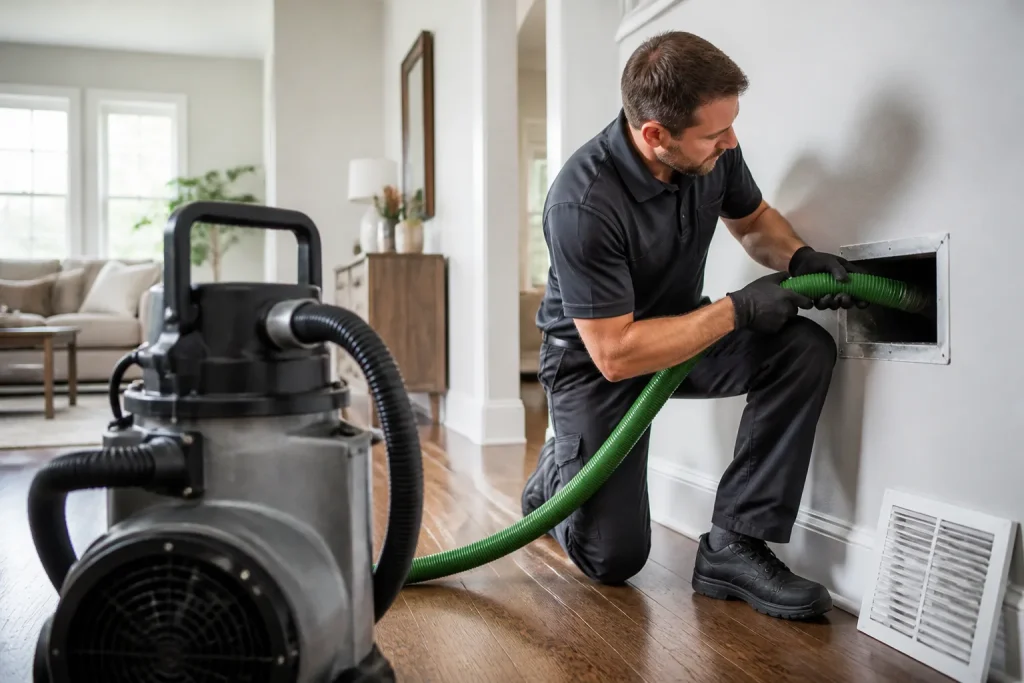
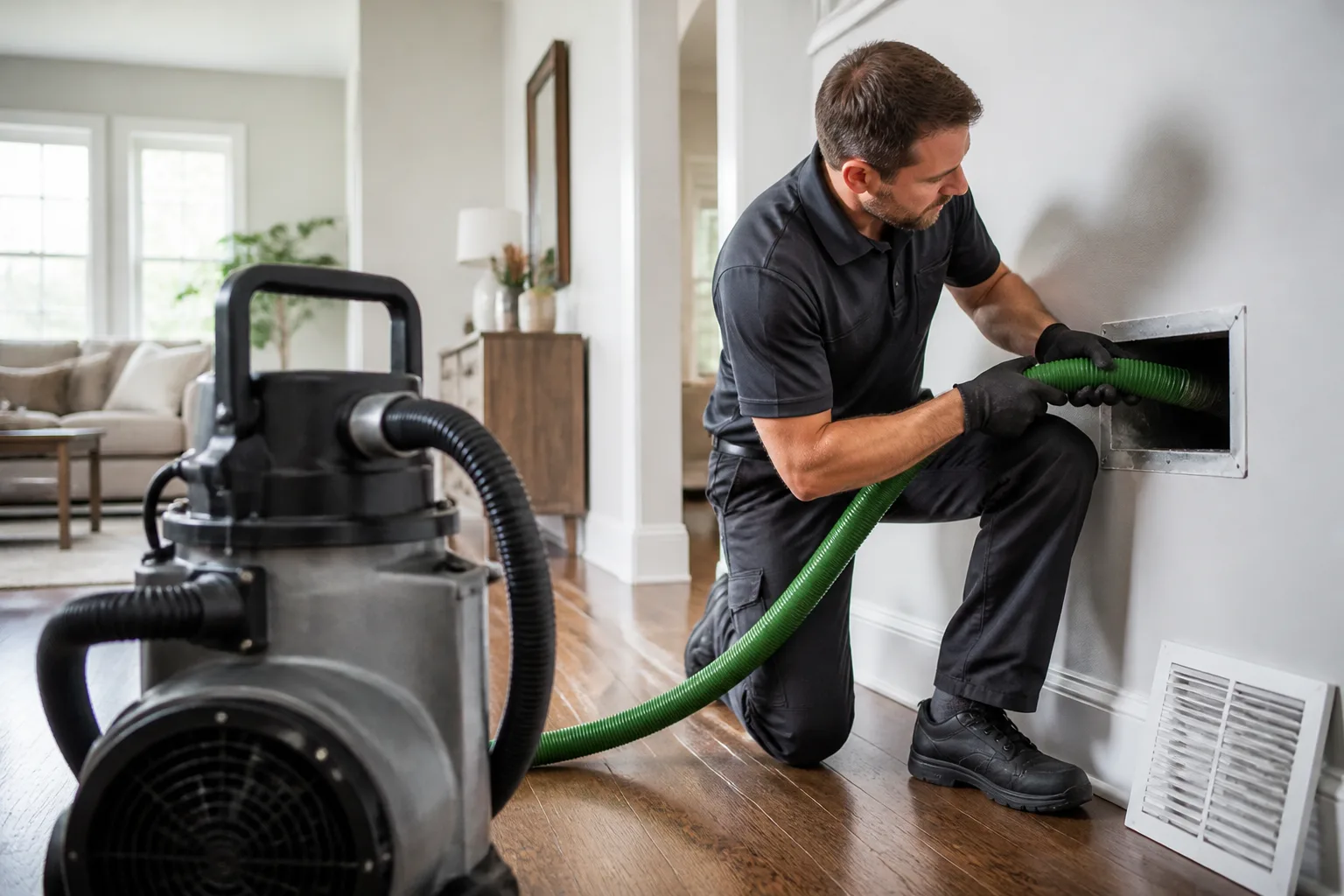
What a restoration-grade unit looks like. A trailer-mounted or van-mounted HEPA unit, usually on its own frame with a filter stack you can see and a thick flexible hose to a containment port. It will look industrial. The brand names often visible: Rotobrush rotary brush equipment for mechanical agitation, Nikro for the vacuum side, Abatement Technologies for negative-air containment. Those are the machines restoration and remediation contractors use, because the same principles apply: contain the contaminant, filter it, verify it’s gone.
What a portable unit looks like. A shop-vac style canister, a short hose, maybe a brush attachment. It’s fine for a garage or a quick surface pass. It can’t move enough air to clear a trunk line, and it has no practical HEPA stage to speak of.
The reason the difference matters is simple: a duct system is not a flat surface. It’s a network of enclosed runs with bends, boots, and transitions that trap debris. Mechanical agitation is what breaks that debris loose. Vacuum is what carries it away. A portable unit does neither at scale. Professional-grade equipment, not portable consumer kits, is the difference between the two.
For the full picture of how the cleaning is done, our Duct Cleaning Denton page breaks down the process step by step.
What Legitimate Post-Service Verification Looks Like
After the work is done, “it looks clean” isn’t a verification. Any crew can pull a register and show you a duct that looks okay three inches in. Real verification is specific and structural.
A specialist should be able to point to these indicators after the job:
- Before-and-after photos of the same runs, shot at the same access points.
- Sealed access points. Any cut the crew made should be closed properly, not taped over in a way that will fail in a season.
- A walk-through of any damage found. If a crushed run or disconnected boot turned up, you should know where it is and what it will take to fix it.
- Filter and register status. Registers should be back in place, filters checked, and the system powered up and running before the crew leaves.
- A clear scope statement of what was done and what wasn’t. Honesty about limits is a quality signal in itself.
If a company can’t walk you through the work with those terms, the cleaning probably didn’t reach system-level contamination removal. It reached the parts you could see.
When to Call a Pro Instead of Waiting
Some homes can wait a bit. Others shouldn’t. Call a professional for a proper assessment if you notice:
- Visible dust streaks or dark lines around the supply registers
- An increase in allergy symptoms indoors that doesn’t track with seasonal pollen
- Pet dander or hair accumulating visibly in the returns
- Musty or stale odor coming from the vents when the air comes on
- Duct noise, whistling, or rooms that never get good airflow, which often points to a damaged or disconnected run
- A recent renovation, move-in, or inherited older home where you don’t know the last cleaning date
That last one matters in Denton. Home turnover is fast, and previous owners rarely leave behind service records. Our Denton page covers what we typically see on local properties.
Related Services in Denton
If your system already has a whole-home filter system installed, say from Honeywell or Aprilaire, we’re familiar with both and can service the ducts without disrupting that investment. Many homes we look at also need air duct cleaning paired with repair work rather than cleaning alone. And separately, our dryer vent cleaning service addresses a fire-safety issue that’s just as important and often missed: lint accumulation in the vent line is a leading cause of residential fires. It’s a dedicated service, not an add-on.
One more note on professionalism, and it’s a small one: if the company you call can’t tell you their vacuum’s CFM rating but can tell you every coupon they’re running, that’s your answer.
What happens when you call
- 1
A real person answersNo phone trees – you reach a local pro.
- 2
You get an upfront price rangeHonest numbers before anyone is dispatched.
- 3
A background-checked tech heads outLicensed & insured, dispatched right away.
- 4
You approve before work beginsNothing starts until you say go.
The Bottom Line
The right Denton duct cleaning company passes the equipment test before it passes the review test. Ask about CFM, HEPA filtration, negative air, access strategy, and photo documentation. Ask for an estimate that starts with your home’s square footage and vent count. Look for a company that can handle duct repair if the cleaning turns up damage. And verify the work when it’s done with before-and-after photos of your own system, not a promise that everything is “all clear.”
If you’re in Denton and need help sorting out your ducts, Duct Cleaning Denton offers free estimates. Our technicians have up to 11 years of experience, we use Rotobrush, Nikro, and Abatement Technologies equipment, and we’re happy to answer any of the five questions above before you book. Call (888) 890-4255. We answer 24/7. Fast dispatch from 7am to 7pm, Sunday through Friday.
Frequently Asked Questions
Cost depends on the size of the home, the number of vents, and the condition of the runs, so pricing is quoted per job by the written estimate. A real company will ask about square footage and vent count before quoting anything. Call (888) 890-4255 for a free estimate on your specific system.
Cheap quotes usually reflect portable shop-style equipment and a quick surface pass rather than system-level removal with professional-grade machinery. A low price with no questions about your home is a sales call, not an assessment. Get an estimate that starts with your actual system, and call (888) 890-4255 if you want to compare.
Ask for before-and-after photos at the same access points. A professional should be able to show you the runs, walk you through any damage found, and confirm the access points were sealed properly. If a company can’t show proof, the work probably didn’t reach the parts you can’t see. Call (888) 890-4255 to schedule an inspection.
No. NADCA certification applies to the individual technician and NADCA membership applies to the company, but neither guarantees the equipment, the access strategy, or how the crew handles damage found mid-job. Use the badge as a starting filter, then ask the equipment questions. Call (888) 890-4255 if you want those answers up front.
It depends on your home. Homes with pets, allergy sufferers, recent renovations, or no known cleaning history tend to need it sooner. Homes that have been serviced recently and have no symptoms may not need it for a while. A proper inspection will tell you where you stand, and we’re glad to take a look. Call (888) 890-4255.
Written by the team at Duct Cleaning Denton.
Need Air Duct Cleaning Help?
Call Duct Cleaning Denton - licensed & insured, with free written estimates in Denton.
(888) 890-4255