
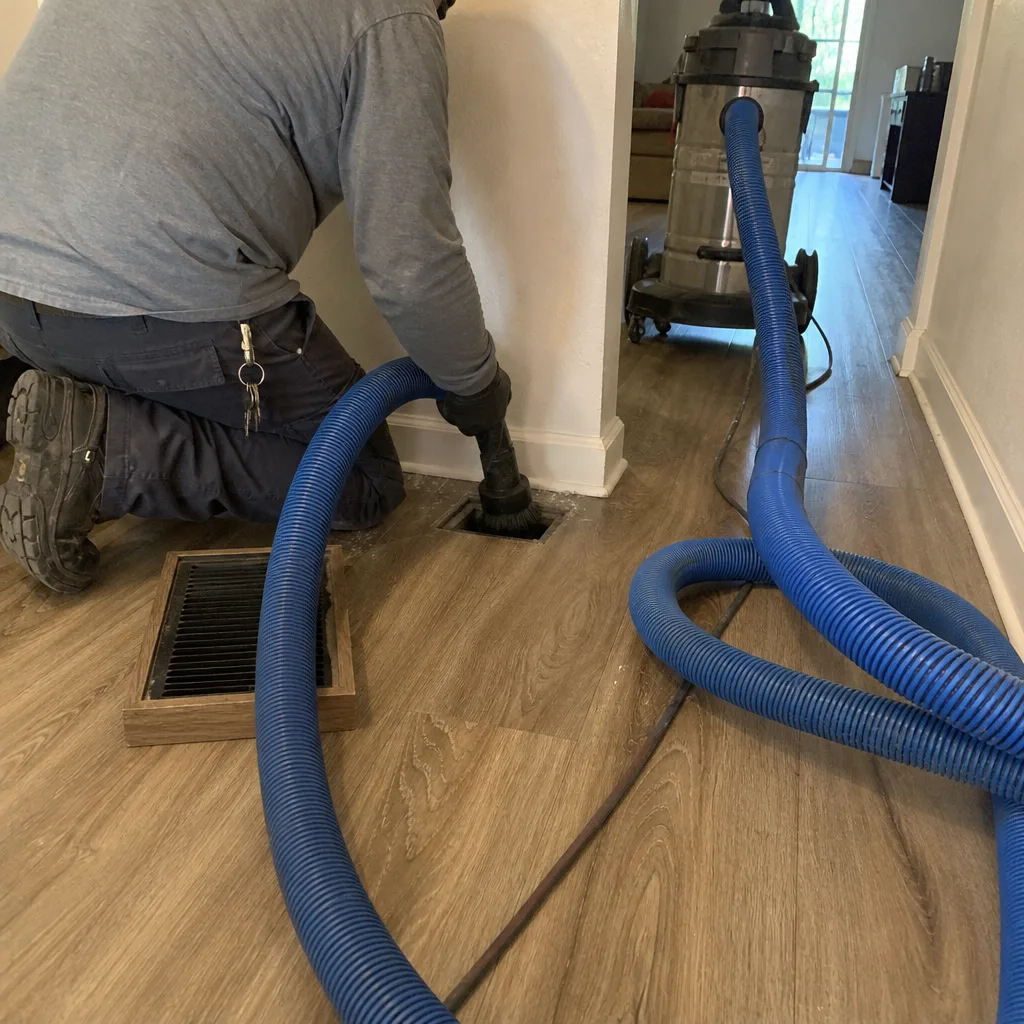
Last updated November 15, 2026
 Whole-home duct cleaning
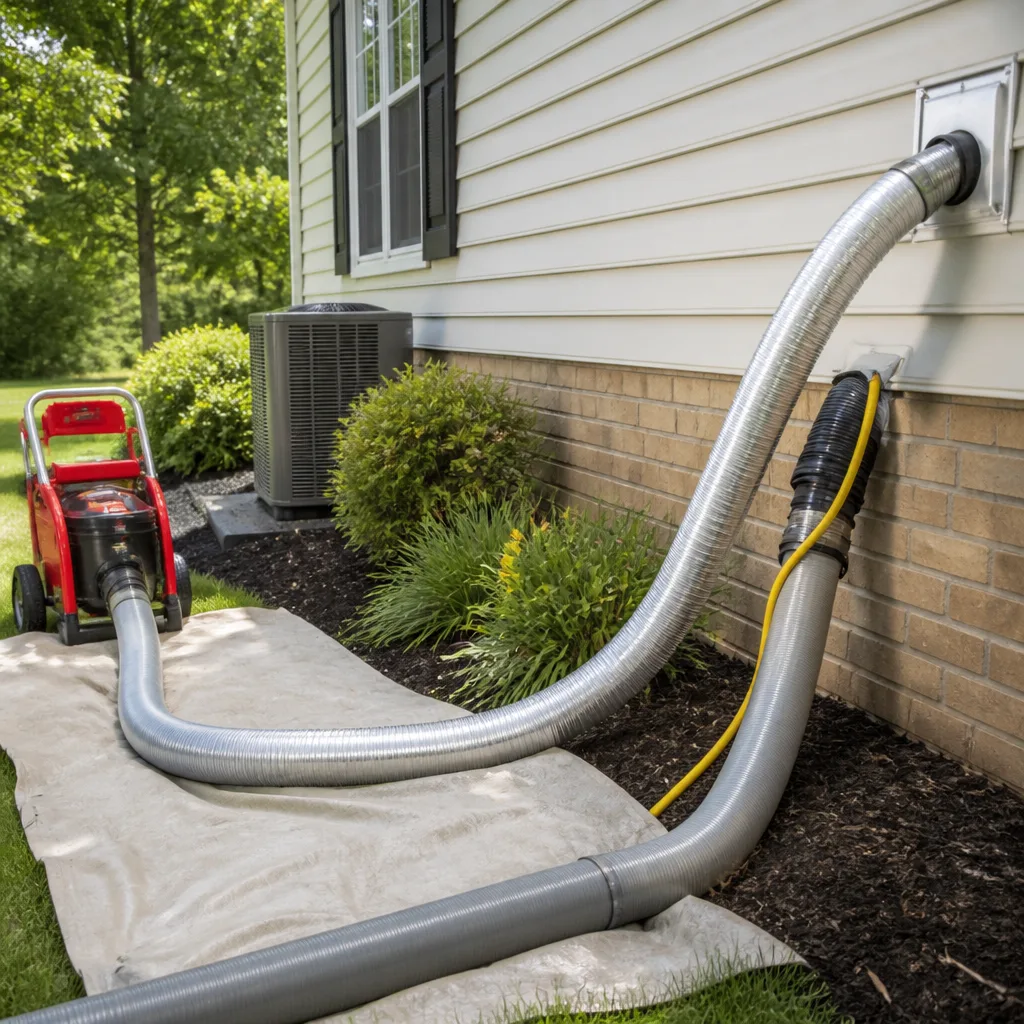
 Dryer vent cleaning
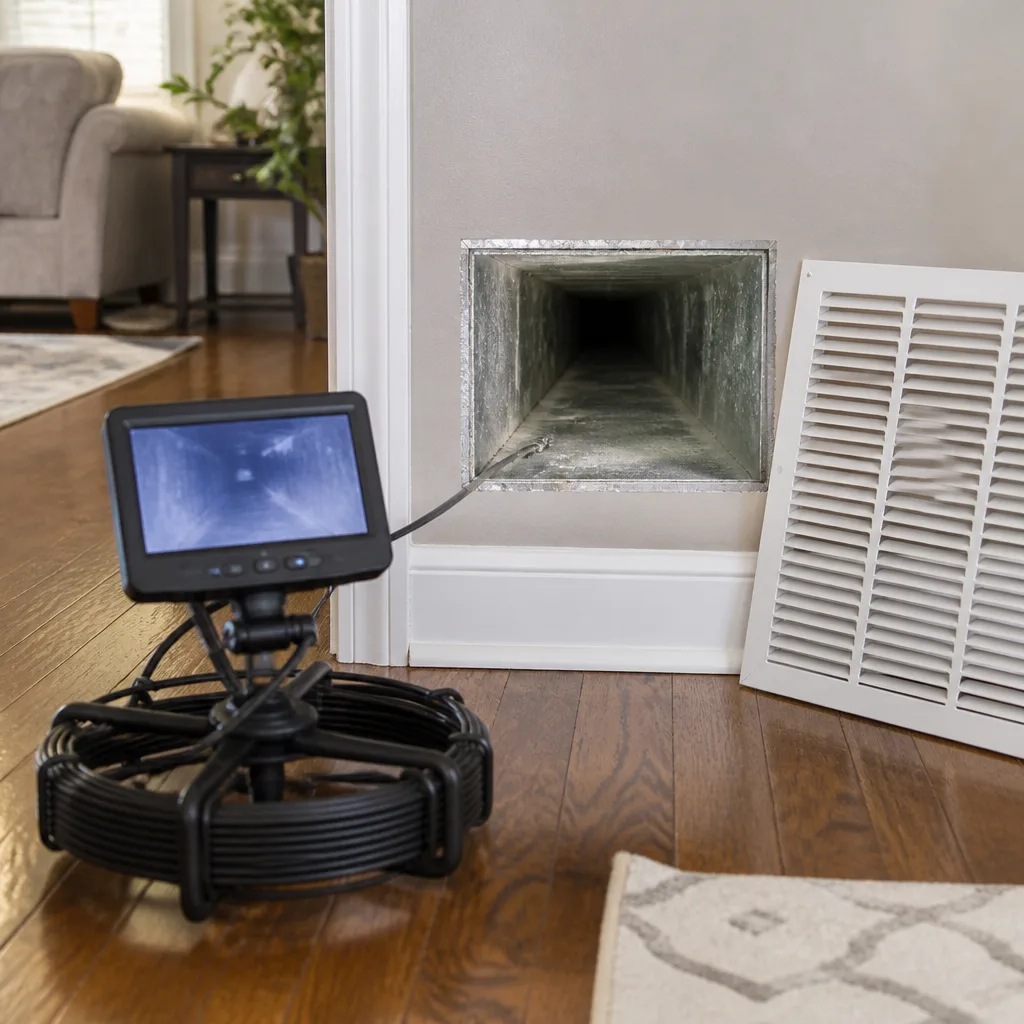 Camera inspection
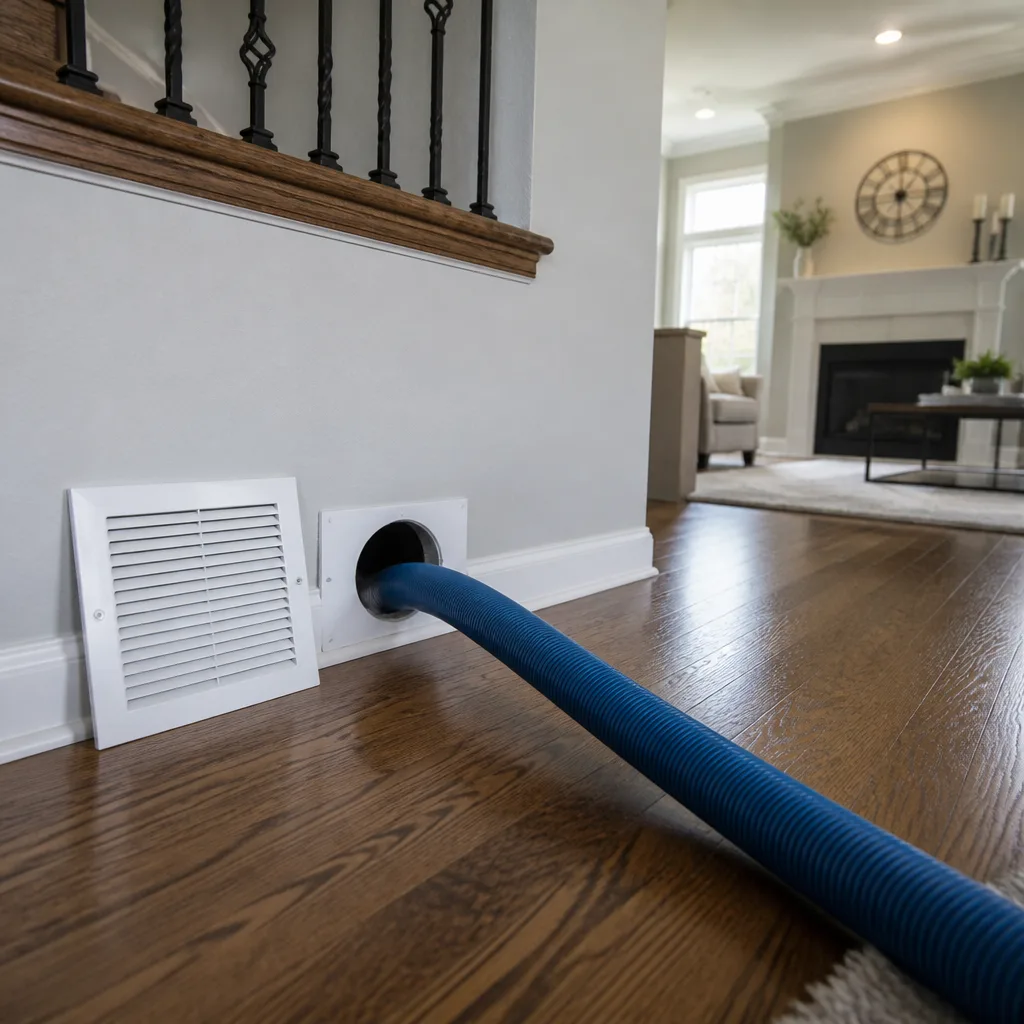 Sanitizing & deodorizing
Whole-system duct and dryer vent check with before-and-after photos - you see exactly what came out of your vents
That "$99 whole-house special" is a bait ad - the real number appears once they are in your hallway, or the "clean" is a shop-vac at the register. We photograph the inside of your ducts before and after instead.
The Complete Guide to Air Duct Cleaning in Denton
Most Denton homeowners assume their ducts are either clean or dirty, and that a vacuum will fix the dirty ones. The truth is that a duct system in North Texas rarely fails on dirt alone. It fails on bonding – fine particulate that settles onto duct lining, picks up seasonal humidity, and cures in place like a thin film. That film doesn’t blow loose with a shop vac. It has to be mechanically broken down before extraction means anything. Denton sits at the meeting point of clay-soil dust moving in from rural corridors to the west and humid Gulf air pushing north, and those two pressures interact inside your ductwork in ways most DFW cities don’t experience at the same intensity. This guide explains what actually separates a system-level restoration from a glorified vacuuming job, and what to demand before anyone touches your system.
Quick Answer
Professional air duct cleaning in Denton means mechanically agitating every interior duct surface with a rotary brush system, containing the dislodged debris under negative pressure, and extracting it through HEPA filtration – not blowing dust around with a portable vacuum. A real system-level job treats supply runs, return runs, the plenum, and every register as separate work zones. The result should be verifiable against the NADCA ACR standard, not promised verbally. Call (888) 890-4255 for a free estimate on your Denton home.
Styles & brands we work with
- Whole-home duct cleaning
- Dryer vent cleaning
- Camera inspection
- Sanitizing & deodorizing
Table of Contents
- Why Denton’s Climate and Soil Make Duct Contamination Worse
- Truck-Mounted Negative Pressure vs. Portable Units: The Equipment Gap That Decides Results
- What a Full System Clean Actually Includes (and What Most Low-Cost Providers Skip)
- How Duct Material and HVAC Age Change Both Method and Outcome
- How to Verify the Work Was Done Right: The ACR Standard, Step by Step
- What Air Duct Cleaning Costs in Denton
- When Cleaning Isn’t Enough: Air Duct Repair and Leaking Systems
- Dryer Vent Cleaning: A Separate Safety Service Worth Understanding
Why Denton’s Climate and Soil Make Duct Contamination Worse
Denton has a specific combination of pressures that accelerate duct contamination relative to most of the DFW metro. The soil around Denton is clay-heavy – expansive black and red clays that crack and powder in dry spells and swell when wet. That clay produces a fine, silica-rich dust that behaves nothing like the sandy grit you’d find in a coastal city. It’s adhesive. It clings to duct walls and flex liner in a way that simple airflow won’t clear.
Layer on top of that the cross-regional wind patterns. The open ranch and farmland west of Denton generates airborne particulate that moves east across the city on dry spring days and during extended summer dry spells. Your HVAC system pulls that air in through the return, filters what it can, and sends the rest downstream into the ducts.
Then comes the humidity. North Texas swings between very dry and very humid conditions across a single season. When humid air moves through ducts carrying clay dust, the particulate bonds to the duct lining and cures as a film. That’s the difference between loose dust (removable with decent airflow) and adhered contamination (needs mechanical agitation to break the bond).
In practical terms, this means three things for a Denton home:
- Contamination builds faster than the national average because two particulate sources (local clay soil and regional wind-borne dust) feed the same system.
- Adhesion is higher once contamination lands, because seasonal humidity bonds it to surfaces.
- Vacuum-only methods underperform here compared to cities with consistently dry air, because they can’t break the bonded film.
If you’ve recently bought a home near the courthouse square or in one of the older neighborhoods like Denton‘s historic districts, this is the reason a “quick clean” on a turn-of-the-century house often produces disappointing results. The contamination is bonded, not loose.
Truck-Mounted Negative Pressure vs. Portable Units: The Equipment Gap That Decides Results
The single biggest predictor of how much debris actually leaves your duct system is the equipment. Not the technician’s attitude, not the price, not the review count. The equipment. This is the gap most homeowners never see until after the invoice arrives.
There are three tiers of equipment in the duct cleaning trade:
- Portable shop-style vacuums – consumer or light-commercial vacuums with HEPA canisters. Extraction is weak, negative pressure isn’t well-contained, and dislodged dust can recirculate into living space. This is what many low-cost providers use.
- Truck-mounted negative pressure systems – a high-CFM vacuum unit connected to the duct system through the access point. Pulls sustained negative pressure through the entire duct network, so loosened debris has one direction to travel: out.
- Professional rotary agitation paired with truck-mount extraction – a rotating brush whip run through each individual duct run to break the bond between contamination and duct surface, while truck-mount extraction pulls everything out under negative pressure and HEPA filtration.
Only the third tier handles adhered contamination in a Denton home. Rotary agitation is what breaks the humidity-cured film. Truck-mount extraction is what removes it. Skip either half and you get the blow-and-go pattern that gives the whole industry a bad name.
We work with Rotobrush rotary brush systems for the mechanical agitation stage and Nikro HEPA-filtration vacuum equipment for contained debris removal. For containment we use Abatement Technologies negative-air practices, so dislodged contaminants stay inside the system during the cleaning rather than drifting into your living room. That specificity matters more here than in cities with looser dust. When you compare quotes for air duct cleaning in Denton, ask which of the three tiers above each provider is using. The quote will tell you a lot.
What a Full System Clean Actually Includes (and What Most Low-Cost Providers Skip)
The gap between a real system-level clean and a cheap one isn’t a matter of degree. It’s a matter of scope. A completed job touches every part of the system. A partial job touches only the parts that are easy to reach.
Here’s what a legitimate full system clean covers, in order of how a job usually runs:
- Register pulls. Every supply and return register is removed so the duct run behind it can be accessed. Registers themselves get cleaned before reinstall. Providers who skip this can’t reach the first several inches of each run.
- Plenum access. The main trunk and plenum – the wide boxes where the air handler meets the duct system – are opened so the rotary brush can run through. This is where most of the debris mass sits. Skipping plenum access is the single most common shortcut.
- Supply-side rotary agitation. Each individual supply run gets the rotary brush run through it end-to-end. Rigid runs need different brush heads than flex runs.
- Return-side treatment. Returns are treated as a separate system from supplies. They’re usually dirtier because unfiltered air travels through them.
- Negative-pressure containment throughout so nothing dislodged recirculates into rooms.
- Register reinstall and post-clean verification with before-and-after documentation.
What most low-cost providers actually do: pull the return grille, run a hose into the plenum for twenty minutes, and call it done. No register pulls. No supply-run agitation. No return-side treatment. Some don’t even open the plenum. That’s why the price looks so much lower – roughly half the actual work is missing.
How Duct Material and HVAC Age Change Both Method and Outcome
Not every Denton duct system responds the same way to cleaning, and pretending otherwise sets homeowners up for disappointment. Three factors drive how a job needs to be run and what outcome is realistic.
Flex duct
Common in newer construction and in retrofit work. Flex duct has a corrugated interior lining that traps particulate in the ridges. Rotary brush cleaning works well here, but the brush head must be sized to the flex diameter – oversized heads can damage the liner. Expect the best results from cleaning when flex is properly brushed rather than vacuumed in place.
Sheet metal duct
Most common in older Denton homes. Galvanized sheet metal is forgiving to clean because the interior is smooth. Contamination sits on the surface rather than embedding in ridges, which makes rotary agitation highly effective. The downside: sheet metal runs often have seams and joints that loosen over decades. Cleaning a leaking duct system without also repairing it is wasted effort.
Fiberboard (duct board)
The trickiest material. Fiberboard has an exposed fibrous interior that traps particulate aggressively but cannot tolerate aggressive brushing. The cleaning approach is gentler and the realistic outcome is “meaningfully improved, not restored to new.” Occupants with fiberboard duct and heavy contamination sometimes face a choice between deep cleaning and replacement. Honest providers will tell you which side of that line your system sits on.
How to Verify the Work Was Done Right: The ACR Standard, Step by Step
You shouldn’t have to take a technician’s word for whether your ducts are clean. The National Air Duct Cleaners Association publishes the ACR standard (Assessment, Cleaning, and Restoration of HVAC Systems), which defines what “clean” means in a way that’s checkable after the work is done. Here’s how a homeowner can use it.
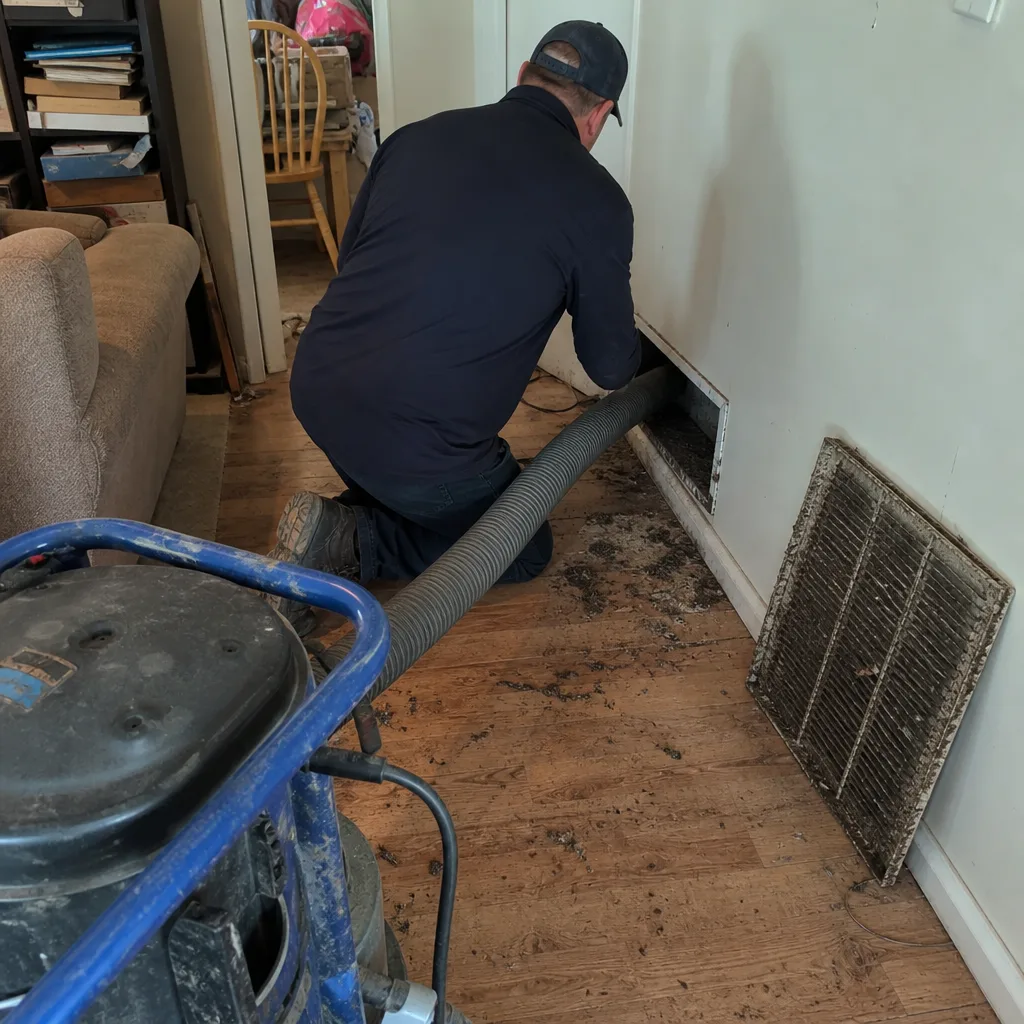
- Ask for pre-clean photos first. A reputable provider takes photos of the duct interior before work starts, showing the contamination that’s actually present. Insist on it.
- Confirm scope in writing before work begins. The estimate should name each area being treated: register pulls, supply runs, return runs, plenum. Verbal scope is how surprise charges happen.
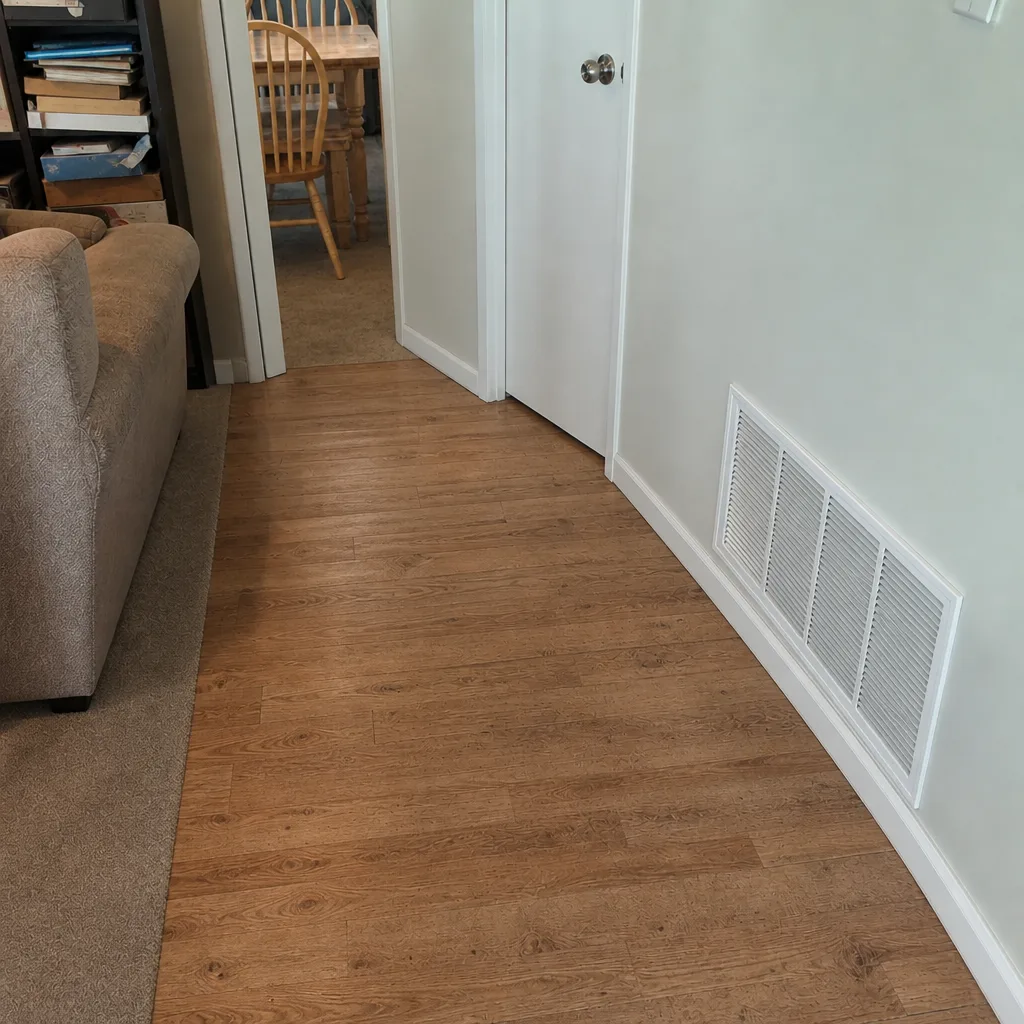
- Ask for before-and-after photos of your own ducts. Not stock photos. Yours. From the same angles where possible.
- Do a surface check post-clean. After the system is cleaned, a flashlight shown into a register (after removing the grille) should reveal visible duct interior, not a dust film. That’s a partial but useful check.
- Request a documented verification. A good provider can tell you what evaluation method they used and what the result was. “It looks clean” isn’t a verification.
- Note whether sealing was recommended. If the ACR assessment finds leaks at seams or joints, sealing is part of restoring the system, not an upsell.
If you’ve invested in whole-home filtration – a Honeywell or Aprilaire system with upgraded media cabinets – also ask whether the post-clean airflow check was done with the filtration in place. Cleaning without confirming system performance against the filtration you already paid for is incomplete.
What Air Duct Cleaning Costs in Denton
Air duct cleaning in Denton runs whole-system, not per-vent. Providers who quote “per register” pricing are almost always the same providers who skip half the scope. Whole-system pricing reflects the real work: full supply and return treatment, plenum access, register pulls, mechanical agitation, and post-clean documentation. Costs vary with system size, duct material, and how much contamination needs to come out, so treat any number as a starting estimate – the written estimate for your specific system is what counts.
Here’s a rough map of what different scopes look like:
- Partial clean (grille-only vacuum): cheapest quote, misses most of the system, and where the bait-and-switch reputation in this trade comes from. Avoid.
- Full system clean, small home, accessible ductwork: the entry point for a legitimate full-scope job, with supply and return runs treated and documentation included.
- Full system clean, larger home or multi-zone system: comes in higher because more duct runs, more registers, and more plenum area are covered.
- Clean plus duct repair: higher still when the assessment finds leaking joints, disconnected runs, or crushed flex. Repair work is often what actually restores system performance, not the cleaning alone.
When you compare quotes from providers in Denton, the question to ask is: “Does this price include register pulls, supply-side agitation, return-side treatment, plenum access, and post-clean documentation?” If any of those are missing, the cheaper quote is not cheaper. It’s just a smaller job.
When Cleaning Isn’t Enough: Air Duct Repair and Leaking Systems
A duct system can be dirty and healthy, or clean and broken. Cleaning a system with leaks, disconnected flex runs, crushed duct sections, or failed seals is wasted work – the system will re-contaminate faster than a sealed system would, and you won’t get the airflow improvement you’re paying for.
Common problems that come up during a Denton duct assessment:
- Disconnected flex runs. Common behind registers where tape or zip ties have failed after years in attic heat. Those runs are dumping conditioned air into the attic, not the room they should be serving.
- Crushed or kinked flex. Kinks restrict airflow to the point where a room never heats or cools properly regardless of the thermostat.
- Failing sheet metal seams. Older Denton homes with original sheet metal runs often develop leaks at seams and joints that need sealing as part of the restoration.
- Missing register boots or damaged boots. Gaps where the boot meets the duct allow dust entry and air loss.
We handle air duct repair alongside cleaning, which means a single assessment covers both questions: what’s dirty, and what’s broken. Providers who only clean will tell you the system needs cleaning even when the real problem is a disconnected run. Getting both evaluated in one visit is the honest way to spend money on a duct system.
Dryer Vent Cleaning: A Separate Safety Service Worth Understanding
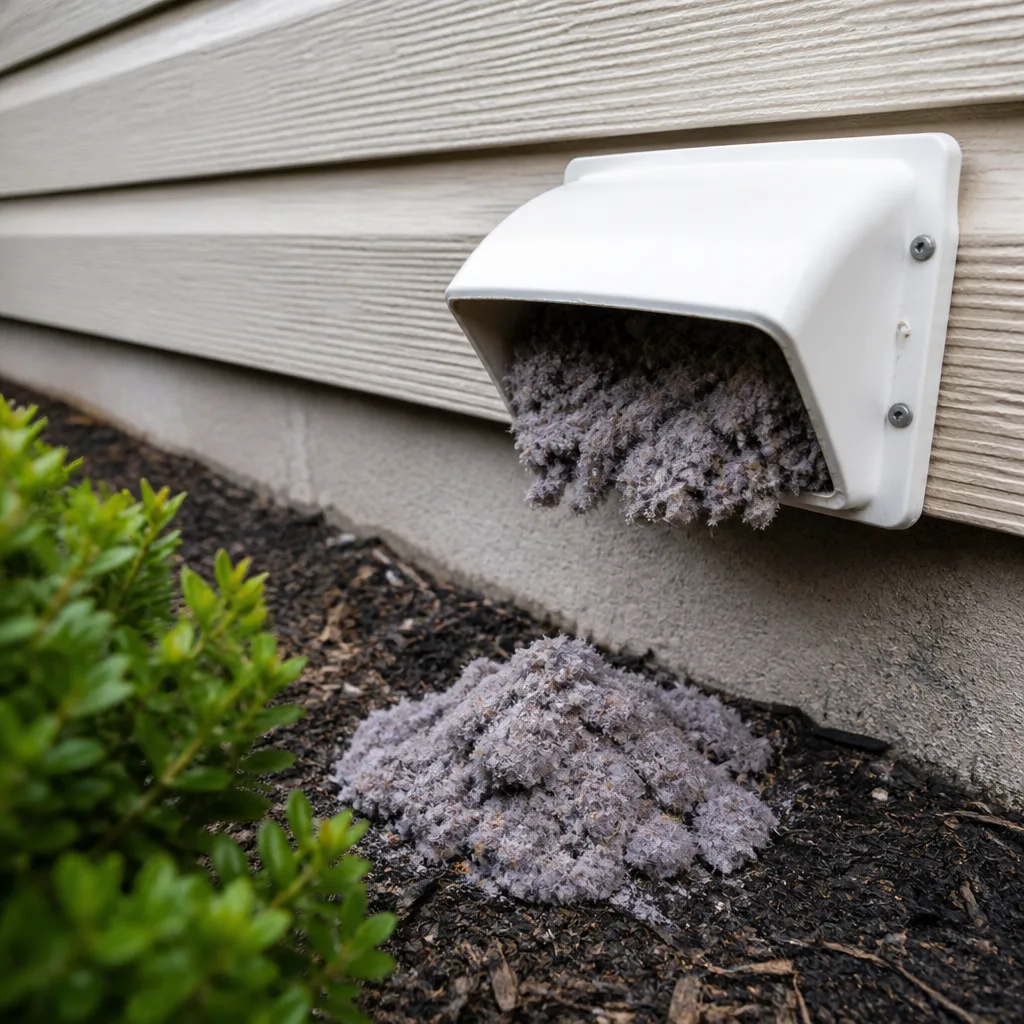
Dryer vent cleaning is a separate service from air duct cleaning, and it deserves that separation because the risk is different. A clogged dryer vent is a fire hazard, not just a performance issue. Lint accumulates in the vent run, restricts airflow, and at the temperatures a dryer produces during a normal cycle, that lint can ignite.
Most Denton homeowners don’t think about their dryer vent between appliance checkups. But the same clay dust and seasonal particulate that enters the home through the HVAC return also enters the dryer vent through the exterior termination, and it mixes with lint to accelerate buildup. A long or heavily-bent vent run in an older Denton home makes the problem worse.
Signs the vent needs attention:
- Clothes take longer than one cycle to dry, and the problem is getting worse.
- The dryer feels hot to the touch on the outside during operation.
- The exterior vent flap doesn’t open fully, or doesn’t open at all, when the dryer runs.
- You can see lint buildup around the damper or inside the vent hood.
- It’s been more than a year since the vent was last cleaned.
This is a service we do as its own job, not as a package add-on to duct cleaning. When you’re scheduling dryer vent cleaning for a Denton home, schedule it as the safety-critical service it is.
Common Mistakes to Avoid
- Booking on price alone. The cheapest quote is almost always the smallest scope. Identifying which parts of the system a quote covers is what matters.
- Accepts per-vent pricing. Any provider quoting per register in Denton is signalling that scope is negotiable, which means the plenum, supply runs, and return runs likely aren’t included.
- Not asking about equipment. A provider who can’t name their extraction equipment and containment setup is probably using portable vacuums. Ask about rotary agitation, truck-mount extraction, and negative-pressure containment specifically.
- Skipping the repair question. Cleaning a leaking system without fixing the leaks is money spent twice. Get repair and cleaning evaluated together.
- No documentation. Without before-and-after photos of your own ducts, you have no way to check the work. Insist on them.
- Waiting until symptoms are severe. By the time family members are visibly reacting to air quality, contamination is usually bonded and the job is larger. Annual or biennial assessments keep this manageable.
- Treating dryer vent cleaning as optional. Lint buildup in a vent is a fire risk, not a convenience issue. It belongs on the maintenance calendar.
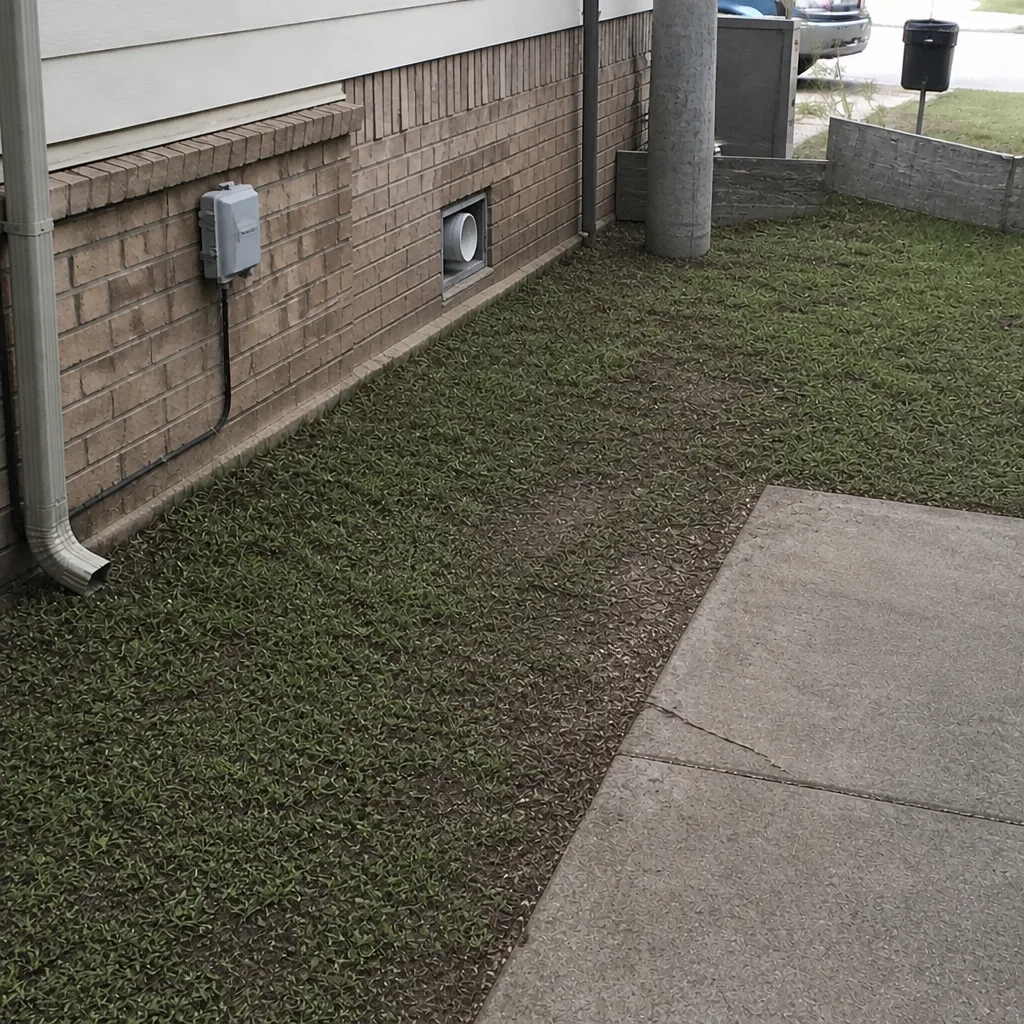
See the difference
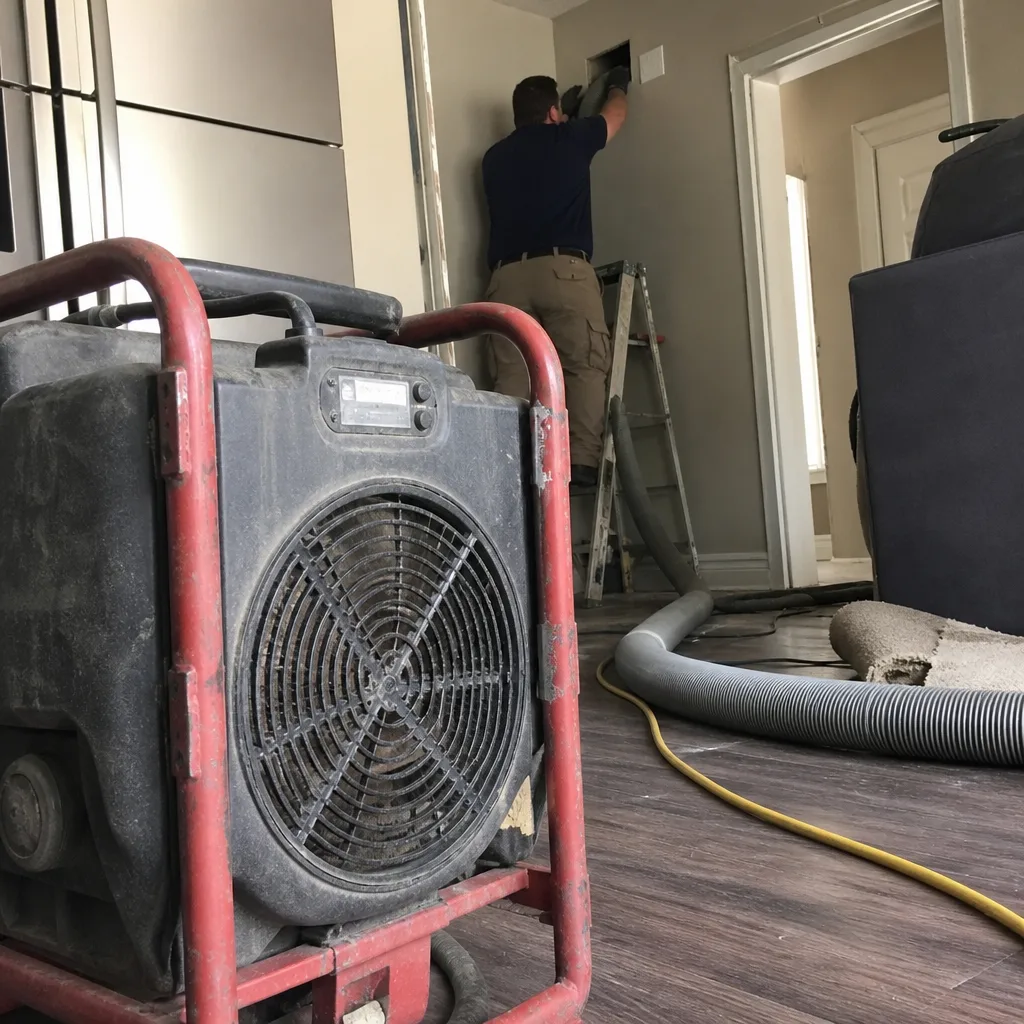 Before
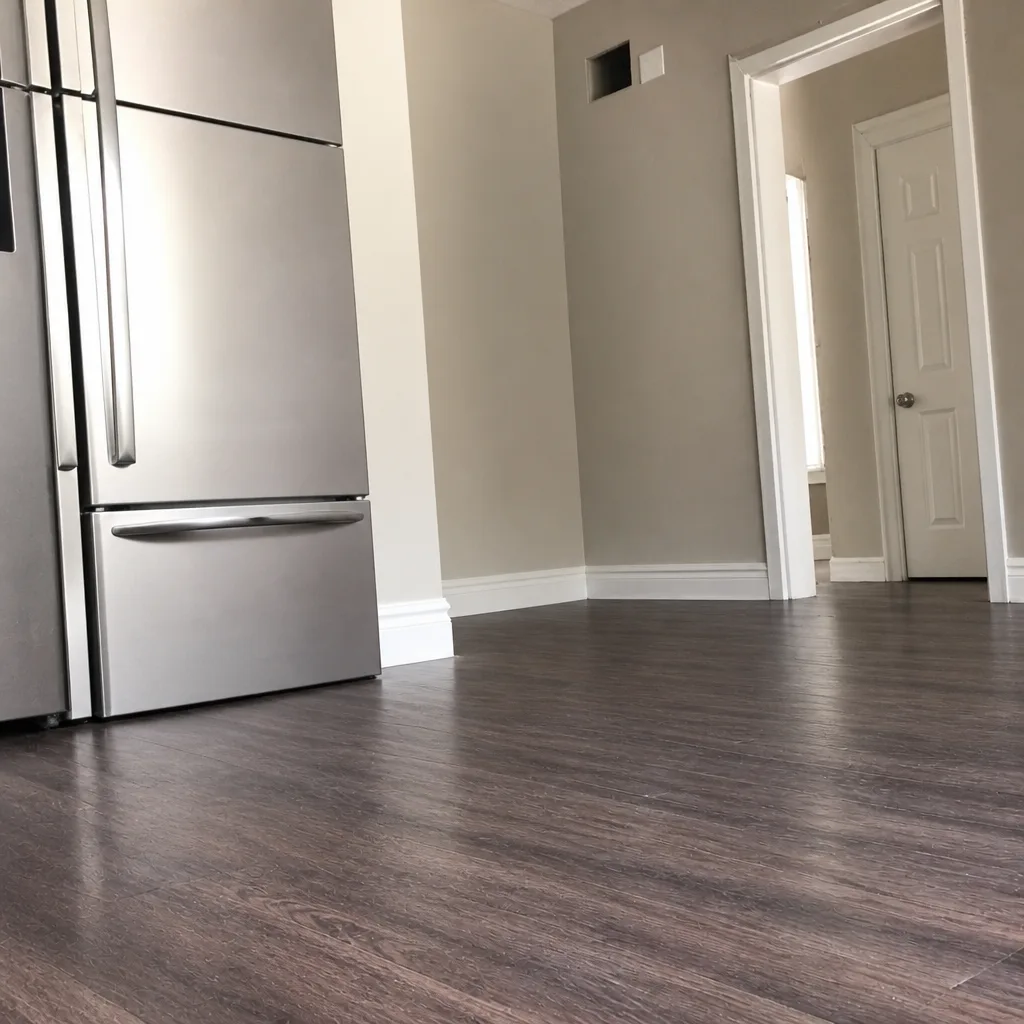 After
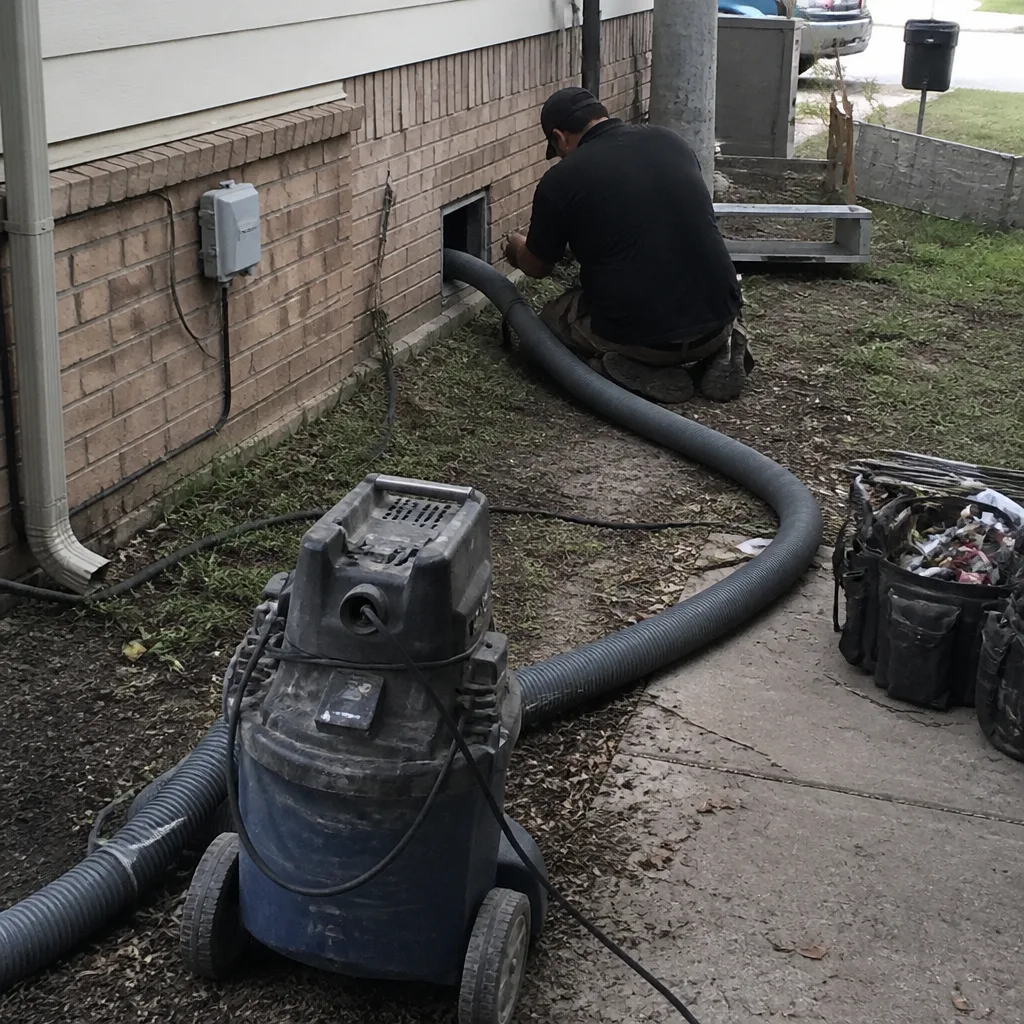 Before
 After
 Before
 After
When to Call a Professional
Call a professional when you notice visual evidence of contamination (dust blowing from registers after cleaning, dark residue around register frames), when family members are reacting to indoor air more than usual, when a home is newly purchased or recently renovated, or when you can’t remember the last time the system was assessed. Also call if your dryer is taking longer than it used to, or if you’ve never had the vent checked. Skip DIY cleaning on any system with damaged duct liner – aggressive brushing of fiberboard or flex can cause real damage. And skip it entirely for anything involving the air handler internals or electrical components; that’s trained-technician work. Duct Cleaning Denton offers free estimates in Denton – call (888) 890-4255. We answer 24/7. Fast dispatch from 7am to 7pm, Sunday through Friday.
Frequently Asked Questions
Air duct cleaning in Denton is priced per whole system, not per vent, so the estimate reflects the actual work on your home: supply runs, return runs, plenum, register pulls, mechanical agitation, and post-clean documentation. The written estimate sets the final price, and cheap per-vent quotes are a red flag because they almost always skip scope. Call (888) 890-4255 for an exact quote – estimates are free.
Cheaper quotes usually mean a smaller job, not a better deal. Providers using portable vacuums and skipping plenum access, register pulls, and supply-run agitation can quote low because most of the work is missing. Ask each provider what their quote includes, and the difference in scope becomes obvious. Call (888) 890-4255 for a quote that spells out every part of the job.
Ask for before-and-after photos of your own duct interiors before work begins, request a written scope covering each area treated, and ask what post-clean verification method was used. A provider working to the NADCA ACR standard can walk you through all three. Call (888) 890-4255 if you want to see what documentation looks like on a Denton job.
For most Denton homes with standard filtration, an assessment every couple of years is reasonable, and a full clean as needed based on what the assessment finds. Homes with pets, allergy sufferers, recent renovations, or newly purchased properties usually need it sooner because of higher particulate load. Call (888) 890-4255 for an assessment and we’ll tell you honestly whether a clean is needed now or later.
Reducing accumulated dust, pollen, and clay-soil particulate in the duct system reduces what can recirculate into living spaces, which helps when contamination is genuinely present. It doesn’t replace filtration, but if the ducts are the source of ongoing load, cleaning removes the source rather than filtering the same particles repeatedly. Call (888) 890-4255 for an assessment.
Yes. We’re familiar with Honeywell and Aprilaire whole-home air quality systems and clean around that existing infrastructure, so post-clean airflow is checked with your filtration in place rather than around it. If you’ve invested in upgraded filtration, the cleaning should be done in a way that respects it. Call (888) 890-4255 to schedule.
The Bottom Line
Air duct cleaning in Denton rewards knowing what to ask for. Clay-soil dust and seasonal humidity bond contamination to duct surfaces more aggressively than in most DFW cities, which means rotary agitation and truck-mounted negative pressure aren’t premium upgrades – they’re the only methods that work here. Full system scope (register pulls, plenum access, supply and return treatment, post-clean documentation) is what separates a real job from a vacuuming. Duct repair belongs in the same assessment as cleaning, not a separate call. Dryer vent cleaning is its own safety-critical service. Verify the work against the ACR standard, avoid per-vent quotes, and ask about the equipment before you book. If you’re ready for a straight answer on your system, call Duct Cleaning Denton at (888) 890-4255 for a free estimate. We answer 24/7. Fast dispatch from 7am to 7pm, Sunday through Friday.
Written by the team at Duct Cleaning Denton.